I Hope This Finds You Well is an exhibition that returns the Imvaba Art Association to the National Arts Festival more than thirty-five years after their last appearance at the Festival and forty years after their formation.
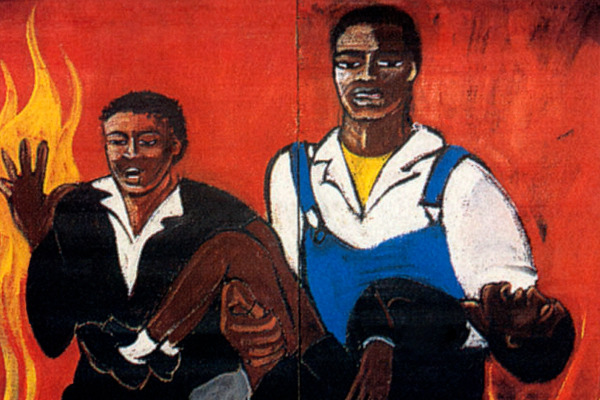
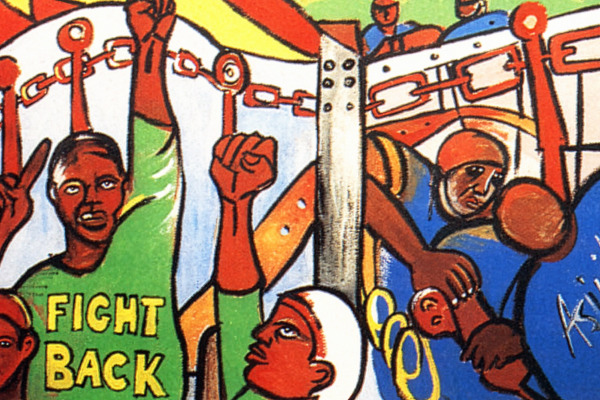
Formed in 1986 in the Eastern Cape during apartheid’s State of Emergency, Imvaba used art, poetry, and collective cultural production as tools for political resistance and community expression. This exhibition focuses primarily on their paintings, which members referred to as Big Posters or Mobile Murals.
Presented in the History Building at the Albany Museum, the project asks how Black artistic practices shaped by struggle, collaboration, and lived experience can exist within contemporary gallery and museum spaces without losing their social and political urgency.
Visitors will encounter paintings, photographs, and archival materials, including a Big Poster whose history raises questions of care, stewardship, and belonging. Together, these works reveal the journeys that cultural objects undertake and the responsibilities involved in sustaining Black cultural memory across generations.
Bringing together works made across different moments and generations, I Hope This Finds You Well traces relationships between artists who used creativity as a form of organisation, remembrance, and political expression. Rather than presenting the archive as a closed record of the past, the exhibition approaches these works as evidence of what people can build together when they choose to have a say.
Ultimately, the exhibition explores how Black art histories might be preserved, activated, and experienced as living cultural practices rather than distant historical objects. It invites audiences to reflect on the enduring relevance of collective cultural action and the ways artistic practices continue to shape conversations about community, responsibility, and the future.
Artist Biography
Imvaba Art Association
Imvaba Art Association was founded in Port Elizabeth (now Gqeberha) in 1986 during the height of apartheid’s State of Emergency (1986). Working across visual art, poetry, mural production, and community cultural activism, Imvaba emerged as a collective of artists committed to making art visible throughout communities in the Eastern Cape.
The organisation worked closely with artists and cultural workers in New Brighton, KwaZakhele, and Motherwell, while also collaborating with anti-apartheid structures including trade unions and community organisations.
Rather than separating art from everyday political life, Imvaba understood cultural production as part of the broader struggle for dignity, liberation, and social transformation. The collective became known for producing banners, murals, posters, exhibitions, and workshops that connected artistic practice to community participation and political education. Their work was exhibited locally and internationally, including presentations at the Grahamstown Festival in 1990 and 1991 and the Art from South Africa exhibition at the Museum of Modern Art Oxford in 1990.
Imvaba’s members included artists such as George Pemba, Lou Almon, Naomi MacKay, Mpumelelo Melane, Michael Barry, Sipho Kulati, Mxolisi Ganto, Lizo Pemba, Titus Pemba, Ayanda Mji, Mxolisi Dolla Sapeta and others who contributed to shaping one of the Eastern Cape’s most significant histories of community-based cultural resistance.
Credits
Curated by: Motlalepula Phukubje
Featuring: Imvaba Art Association, Banele Njadayi, Phumlile Rawana, Vuyo Giba, Khaya Ngcangca, Nadia Foster, Lucreshia Abdool, Tuliwe Mbambaza, Nozuko Mangkwana
In collaboration with: Nelson Mandela Metropolitan Art Museum, The UWC Robben Island Mayibuye Archives
Exhibition venues: Albany Museum and Raw Spot Gallery
Archival and research support: The UWC Robben Island Mayibuye Archives (Art and Artefacts, Audio-Visual and Historical Papers Collection), Africa South Art Initiative
Conservation support: The UWC Robben Island Mayibuye Archives, Nelson Mandela Metropolitan Art Museum and Anthony Keogh
With works and archival material by: Members of the Imvaba Art Association, Banele Njadayi, Phumlile Rawana, Vuyo Giba, Khaya Ngcangca, Nadia Foster, Lucreshia Abdool, Tuliwe Mbambaza, Nozuko Mangkwana
Supported by: Rhodes University- SARChI Chair NRF and National Arts Festival
- Grahamstown Gallery
- Albany History Museum
- Daily during the Festival 09:00 to 17:00
-
Daily entry to the exhibitions is free. The scheduled walkabouts have a minimal cost and booking is essential.