

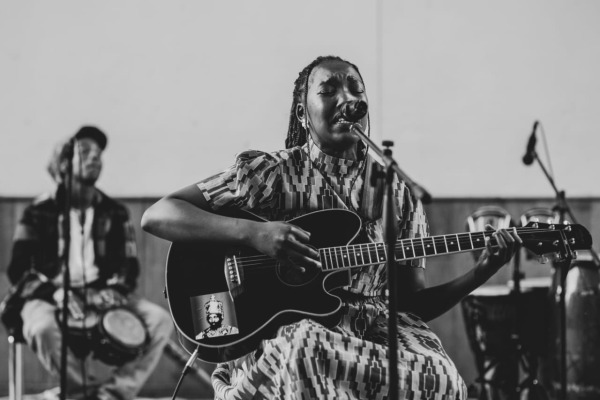
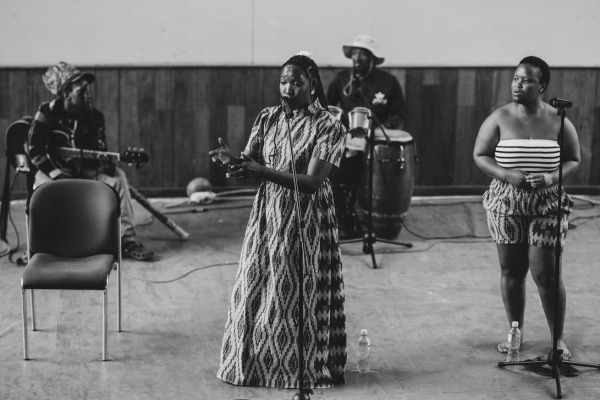
In Gqeberha’s Walmer location, music doesn’t always announce itself with volume. Sometimes it arrives quietly, like a prayer you hum to yourself when the world feels heavy. For Suthu Mandlovu, born Nobesuthu Ndlovu, music has never been an escape from reality. It has been a way of entering it more fully—of reaching toward God, ancestors, memory, and self with open hands.
Mandlovu’s sound lives in what she describes as decolonised art: traditional African music rooted in spirituality, storytelling, and dignity. It is not nostalgic or performative. It is lived. Her voice carries the weight of church hymns, the pulse of the iGubu drum, and the unspoken language of grief and healing. Listening to her music feels less like consuming a product and more like being invited into a sacred space.
Her journey into music began long before any official release. In high school, Mandlovu was part of a drama group called Siyakhuthaza Youth Entertainment, where performance became a place of self-discovery. But it was only later, around 2021, that music fully claimed her. Playing alongside the late Siphiwo Nathan Solomon marked a turning point—one that deepened her understanding of music not just as art, but as spiritual practice.
“Music has always been my runaway place whenever things got hard, including when I’m happy,” she reflects. “I find my God easier when I play.” For Mandlovu, creating music is inseparable from seeking connection with a higher power. It is how she prays, how she listens, how she survives.
Much of that spiritual grounding traces back to her mother, Nomilile Ndlovu, whose voice shaped her earliest memories. Mandlovu recalls hearing her mother sing through difficult moments, carrying pain and faith in the same breath. The style of singing—besombela xa ecula—was uncommon, raw, and deeply expressive. After her mother’s passing, Mandlovu found herself returning to that sound, pairing it with her guitar in a way that felt like reaching across worlds.
“Singing like her and playing my guitar like Mr Nathan Solomon was the only way I would get spiritual hugs from their memory,” she says. “It always feels like they’re close.” In this way, her music becomes a meeting place between past and present, between the living and those who have departed.
Her influences—Miriam Makeba, Thandiswa Mazwai, Zahara, and Sjava—are artists known not just for their sound, but for their moral and cultural clarity. Like them, Mandlovu is less interested in chasing trends than in telling truths. Her songs are guided by a clear intention: restoring and enhancing the dignity of African people. “SingabaNTU abanako,” she says—affirming the fullness, humanity, and worth of African existence.
Growing up in the Zion Church also left a lasting imprint. The slow, deliberate singing, the communal clapping, the central role of the drum—these elements taught her that music is a shared spiritual labour. For years, that music lived quietly inside her. Now, as she gives herself fully to it, her sound is maturing, shaped by experience and a deeper understanding of the spiritual forces at play.
That evolution is most evident in her recent single, “Bawo Wethu,” released on 21 November. Mandlovu describes the song as “yintonga yam endithandaza ngayo”—the stick she leans on when she prays. The track gently strips away rigid ideas of religion, offering instead a more organic, accessible path to the Creator. Inspired by the singing traditions of eMampondweni on her mother’s side, the song feels both intimate and communal, like a prayer meant to be shared.
Unexpectedly, “Bawo Wethu” has become the song that resonates most deeply with listeners. Mandlovu never doubted the power of her work, but she was surprised by how people chose this particular song—especially after it gained traction on TikTok following a video she shared from a show she hosted on 2 March 2025. The response affirmed something she already knew: when music is honest and spiritually grounded, it finds its way to those who need it.
Beyond her solo work, Mandlovu has contributed to collaborative projects, including “Bhabhela Phezulu” featuring Ntombekhaya Nomkhalo under the History Reimagined project, and a feature on “Phumla” by DJ T.S.U. Each collaboration expands her sonic world while keeping her rooted in purpose.
The path hasn’t been without its challenges. To carry spirituality, grief, and cultural responsibility in one’s art requires vulnerability and patience—especially in an industry that often prioritises speed and spectacle. But Mandlovu’s growth lies in her willingness to honour the process. She understands now that her music cannot be rushed; it must be lived into.
Looking ahead, she plans to release an EP within the year, while remaining open to how and when it takes shape. What she knows for certain is that more beautiful music is coming—music that continues to explore faith, identity, and ancestral memory with care and conviction.
Today, listeners can find Suthu Mandlovu on all social media platforms under @SuthuMandlovu, with her music available across all digital streaming services. But beyond platforms and releases, her work exists as something quieter and more enduring. It is a reminder that music can still be a place of refuge, a form of prayer, and a bridge between worlds.
In a time when noise often drowns out meaning, Mandlovu chooses to sing slowly, deliberately, and truthfully—toward God, toward her ancestors, and toward a future grounded in dignity.
- Venue: The Black Power Station
- Location: The Old Power Station
- Ticket price: ZAR 150.00
- Programme type: The Fringe
- Genre: The Black Power Station Session
- Duration: 60 minutes
-
Ages:
ALL AGES
- Language: isiXhosa
- Other Languages: English