
When things are not okay – the personal, the provincial, the living and the indigenous, humiliated by poverty and powerlessness – inversions work to inhibit any assumption of ‘okay-ness’ itself. Innocence suffers, though not without the question of how it can be reclaimed. Psychologist David Watson reminded Jones, during his depression and severe not okay-ness, of the true meaning of re-spect, which is – to look, again. When brute ‘knowledge’ obscures reality, or brute force seemingly eliminates the evidence of life – ‘look, again’.
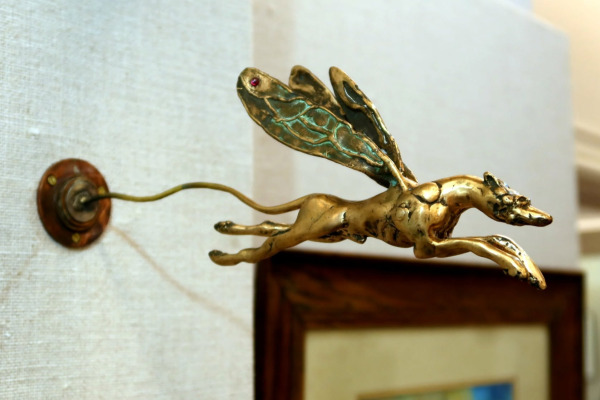
If everything living holds within it seeds for beauty, Jones has nurtured this potential throughout his life through his creative work as well as his ecological commitments. He honours land as it was and could be, rehabilitating forest and planting indigenous trees to which he tends (over 1000 to date). He also tends to the seeds of his subjects in sculpture, with respect. However, few of these figures in their final sculptural form fully disguise how society has seen them, as commodities embedded in systemic cycles of waste, as profitable labour, trophies or nameless expressions of prejudice.
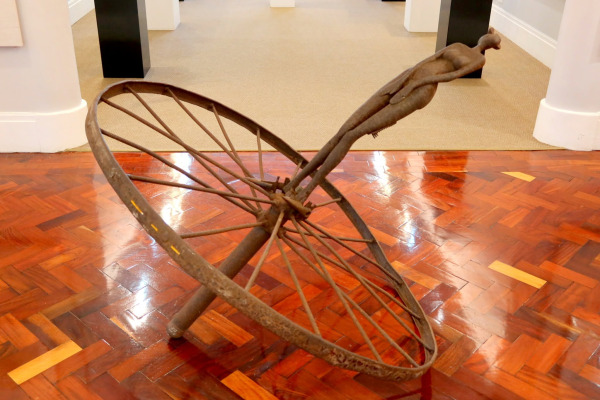
In subtle resistance, Jones’ work brings awareness to those machinations of power that threaten complexity and nuance. Beauty, unaware of itself, becomes a terrifying condition to express, existing so close to the possibility of its abuse. His figures capture the dream and hope for a future in freedom, but do not live in an idealistic fantasy world where power does not exist. They may dance atop burnt wood, that if touched, darkly marks the beholder complicit in their reality. Or they may represent the ecstasy of physical expression, yet on a mechanical grinder that turns manically against inevitability. But what is inevitable? What is taken, and what is a given? What has been taken, and what do we give?
Colonialism has built an inescapable structural reality into hopes for a future – ecologically, economically and socially. The title of Nadine Gordimer’s book of essays, Living in Hope and History (1999) aptly sums up the tensions of this visual moment, shot through with tenderness for what could be, while at the same time, recognising history replete with its violations that have destroyed paper-thin windows of potential where respect might have lived. We meet chief Hintsa in the underworld, riding a bull, and like Orpheus, his dignity lost to recurring myth, but not without the haunting question of its reclamation. We see a man, unjustly lashed, fleeing Olive Schreiner’s Karoo scene with the dream of his freedom ahead, yet his wagon moves dangerously faster and faster in the carved valleys of the stinkwood linenfold, a prized Western form of patterned wooden paneling.
In Jones’ work, in a reorientation of power, it is both the inversions and the minutiae that provide clues to where change might begin. What may look tiny signals where morality, fragile as a candle in the wind, rekindles its flame. Though given and taken references inescapable cycles – the inertia of power, corruption of community and our own natures, the pull of the rut and the pleasure of speed – the act of caring-as-making slows these effects down to a standstill. Noticing, salvaging, seeing again what could be in the remnant, and pushing mediums past their threshold to where transformation begins, is not being resigned to the status quo of ‘things are not okay’. On the contrary, this extreme care contradicts both indifference and despair; calling sincerely for audiences to look again.
Artist Biography
Graham Ashdown Jones (b. 1958) is a Zimbabwean-born fine artist and sculptor based in Gqeberha, Eastern Cape. Captivated by the intricacies of the natural world and the delicate connections that hang in the balance, his practice exists as a gentle, yet remarkably fierce, reckoning with the weight of the human footprint. Having relocated to Knysna with his family during his formative years, the wonders of the forest, alongside a community who deeply cared about the life contained within it, cultivated reverence for its manifold life forms and an awareness of his fragile interdependence within the social and natural world. Born into the thick of colonialism’s machinations and apartheid’s violations, Jones grew through institutions (schooling and tertiary, then a teacher himself) to experience first-hand how beauty can also be humiliated, dignity withheld and justice delayed. His practice today is an act of care, stemming from the awe and responsibility endowed by those who taught him to truly look at the world, and then look, again. Each act, of recording the distinct human subject, of salvaging a discarded piece of wood or plastic, or labouring intensely and sculpturally toward their transformation, is both a reclamation and an act of healing. His work reimagines that which has already been destroyed, or could be destroyed still, entreating the viewer to do the same.
- GFI Art Gallery
- 30 Park Drive, Gqeberha
- Daily during the Festival 09:00 to 17:00